


You’re walking to your car, or along a path, or looking out a window — and a raccoon stops you. Maybe it holds eye contact for a moment longer than you’d expect. Maybe it appears in the middle of the day, which doesn’t feel quite right. Maybe it’s the third time this week you’ve noticed one where you don’t normally see them. Something about the encounter lingers, and you find yourself wondering if it meant something.
The spiritual meaning of a raccoon in your path is worth taking seriously — not because every animal sighting is a divine message, but because raccoon symbolism is specific enough to be genuinely useful if you’re in the right moment for it to land.
Raccoon symbolism at a glance: In spiritual traditions, the raccoon represents adaptability, the courage to examine what’s hidden, resourcefulness in difficult conditions, and the intelligence that comes from being underestimated. It’s not a dramatic animal, spiritually speaking — but its message tends to be pointed, especially when it crosses your path in an unexpected way.
What Does the Raccoon Symbolize Spiritually?
The raccoon is one of the more complex animal symbols in North American spiritual traditions, and its complexity is worth sitting with. This is an animal that thrives at the edges of things — the edge of the forest and the town, the edge of night and day, the edge of what’s socially accepted and what’s considered a nuisance. Its spiritual symbolism reflects all of that boundary-dwelling.
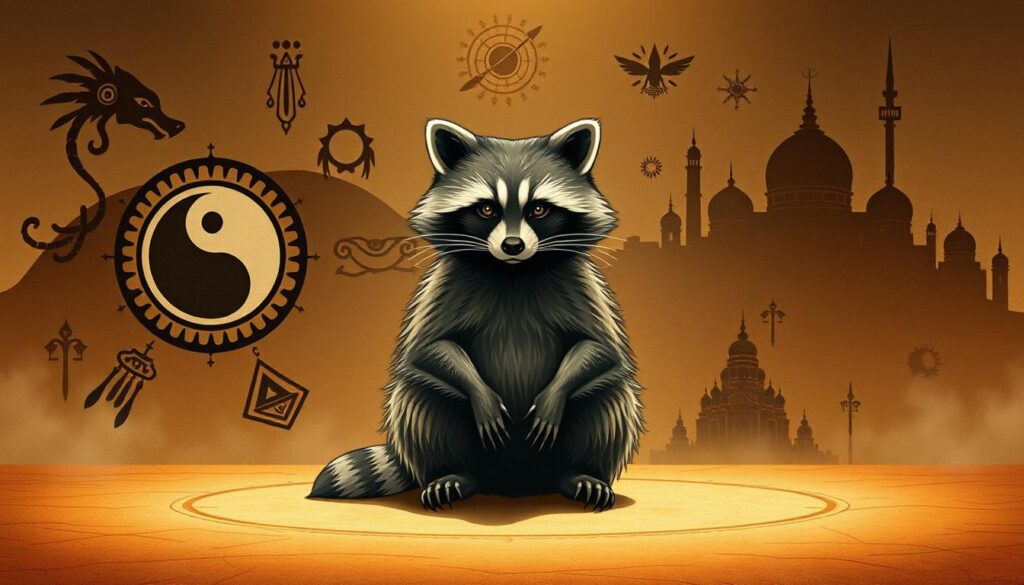
The raccoon’s most visually distinctive feature — the black mask across its eyes — has given rise to the symbolism most associated with it: the examination of what’s hidden, the willingness to look behind appearances, the dual nature of things that present one face while holding another. In spiritual contexts, this isn’t negative. It’s a call to look more carefully, not an accusation of deception.
Its core spiritual associations include:
- Adaptability — raccoons thrive in environments that would defeat less flexible animals; they change their approach based on what’s available
- Resourcefulness — they use what’s at hand rather than waiting for ideal conditions; nothing is wasted
- The examination of hidden things — the mask symbol points toward looking beneath surfaces, including your own
- Curiosity without recklessness — raccoons are bold but not careless; they investigate before they commit
- Dexterity — their hands are among the most sensitive and capable in the animal world, giving them an association with precision, skill, and the ability to handle what others cannot
What I find most interesting about raccoon symbolism is the combination of intelligence and adaptability. This isn’t just “be flexible” — it’s “be clever in how you’re flexible.” The raccoon doesn’t simply adjust to new conditions; it figures out what those conditions actually offer and uses them. That distinction matters in how its message tends to apply.

The Raccoon in Native American and Folk Tradition
In several Native American traditions, the raccoon holds a significant place as a trickster figure — though “trickster” in this context doesn’t mean malicious. Trickster energy is about disrupting fixed assumptions, finding unconventional paths, and teaching through unexpected means. The raccoon’s trickster quality is gentler than the coyote’s, but the underlying principle is similar: things are not always what they appear to be, and the most creative solutions often come from not being bound by how things have always been done.
Among some Algonquian peoples, the raccoon (called aroughcun or similar variants) was associated with cleverness and the ability to make the most of any situation — qualities valued both practically and spiritually in traditions where survival depended on resourcefulness.
In broader folk tradition across North America, seeing a raccoon during the day has often been read as a significant encounter — not because daytime sightings are necessarily alarming, but because they break the pattern. The raccoon’s natural nocturnal rhythm makes its appearance in daylight feel intentional, which tends to give the encounter more symbolic weight than a nighttime sighting would carry.
Raccoon as a Spirit and Totem Animal
If the raccoon appears as your spirit or totem animal — through repeated encounters, dreams, or a consistent pull toward its symbolism — its message tends to be about the intelligent use of what you have, rather than waiting for better conditions or more obvious opportunities.
People drawn to raccoon energy are often dealing with situations where the conventional approach isn’t working and where the instinct to wait for things to become clearer is actually a form of avoidance. The raccoon’s intelligence isn’t theoretical — it’s applied, in real time, to whatever is actually in front of it.
As a totem, the raccoon is also connected to:
- The courage to examine what’s been avoided — the mask isn’t hiding; it’s pointing at what you’ve been looking past
- Practical intelligence over status — the raccoon doesn’t need to be acknowledged as clever; it simply is, and it acts accordingly
- Finding value where others see none — the raccoon’s reputation for sifting through what’s been discarded reflects a capacity to find what’s actually useful rather than what’s been labeled valuable by convention
If the raccoon has appeared as a guide during a particular period, I’d ask: where are you waiting for conditions to be ideal before you act? What would you do differently if you were willing to work with what you already have?
What It Means When a Raccoon Crosses Your Path
A raccoon crossing your path carries a more specific symbolism than simply seeing one from a distance. The crossing — the deliberate movement through your space — tends to carry a message of: pay attention to what’s moving through your life right now, and don’t assume you already understand it fully.
The raccoon’s mask is central here. When it crosses your path, the symbolism often involves being invited to look more carefully at something — a situation, a relationship, a version of yourself — that you’ve been accepting at face value. This isn’t necessarily a warning about deception. It’s more often an invitation to look at your own assumptions: what are you seeing, and is what you’re seeing what’s actually there?
Common interpretations when a raccoon crosses your path:
- A situation is more complex than it appears — something that looks settled may have layers you haven’t examined
- Your resourcefulness is being called on — the current challenge may not respond to the usual approach; something more creative is needed
- Something hidden needs to come to light — either something about a situation or something about yourself that you’ve been managing rather than facing
- An invitation to adapt — not by abandoning what you value, but by being more flexible in how you pursue it
The Spiritual Meaning of Raccoon in Dreams
Dreaming of a raccoon tends to carry the same core themes as a waking encounter, but often with a more personal and specific focus — the subconscious uses these symbols with greater precision than a chance sighting allows.
Common raccoon dream scenarios and what they tend to mean:
- A raccoon investigating something — your own curiosity about a situation is asking to be honored; something warrants a closer look than you’ve been giving it
- A raccoon wearing its mask prominently — questions of identity, authenticity, or the gap between how you present yourself and how you actually feel
- A raccoon in an unexpected place — something is operating outside its usual boundaries; look at where in your life the conventional rules may not apply
- A raccoon that’s friendly or calm — an invitation to engage with something you’ve been approaching warily; the situation may be less threatening than it looks
- A raccoon that’s distressed or cornered — a feeling of being trapped by circumstances, or of having your adaptability constrained; what’s blocking the usual flexibility?
How to Work With Raccoon Energy
If the spiritual meaning of the raccoon feels personally relevant right now, here are some ways to engage with what it’s pointing toward:
Look at what you’ve been taking at face value. The raccoon’s mask symbolism is consistent: it points toward the gap between appearance and reality. This could be in a relationship, a situation at work, a version of yourself you’ve been presenting without questioning. Not as an accusation — as an invitation to look more honestly.
Identify where you’re waiting for better conditions. The raccoon doesn’t wait for the ideal environment. It works with what exists. If you’ve been deferring action until things are clearer or easier, the raccoon asks: what could you do with what you already have?
Notice what you’ve been dismissing as not useful. Raccoons find value in what others overlook. This can translate into: what skill, resource, relationship, or aspect of your own experience have you been undervaluing because it doesn’t fit the conventional picture of what’s useful right now?
Spend some time in the in-between hours. The raccoon’s nocturnal nature and its association with liminal time — dusk, early morning, the edges of things — suggest that something is available in those quieter, less defined periods. Whether that’s actual night-time reflection or simply time spent outside the busyness of your usual day, the raccoon’s medicine tends to be found at the edges rather than in the center of activity.
Frequently Asked Questions
Is seeing a raccoon a good or bad omen?
In most spiritual traditions, the raccoon is a neutral messenger — neither specifically fortunate nor unfortunate. Its meaning is shaped almost entirely by the context of your life at the time of the encounter. If you’re in a period of uncertainty, the raccoon’s adaptability and resourcefulness message tends to be encouraging. If you’ve been avoiding something, its mask symbolism tends to be a gentle but direct prompt to look more honestly. What I’d say is that raccoon encounters are rarely random — if one has caught your attention in a way that lingers, the meaning is usually already visible in what you were thinking about when it appeared.
What does it mean if a raccoon crosses my path during the day?
Raccoons are nocturnal animals, so a daytime appearance tends to carry additional significance — not as an alarm, but as an amplification of the encounter’s intentionality. The pattern has been broken. Something is operating outside its normal timing. Symbolically, daytime raccoon sightings often suggest that what’s been hidden or operating in the background of your life is ready to become visible — that something nocturnal, metaphorically speaking, is being brought into daylight. It’s worth asking what that might be in your current circumstances.
What is the spiritual difference between a raccoon and a fox?
Both animals carry associations with intelligence, adaptability, and the navigation of complex situations — but they differ in emphasis. The fox’s symbolism tends toward strategic cleverness, the ability to outmaneuver obstacles, and a kind of focused cunning. The raccoon’s symbolism is more investigative: it’s less about outwitting something and more about examining it — lifting the mask, looking underneath, finding what’s actually there rather than what’s been assumed. The fox asks “how do I get through this?” The raccoon asks “what is this, really?” Both are useful questions, but they belong to different moments.
The raccoon crosses your path for a reason that tends to be specific to where you are right now. Its intelligence isn’t general-purpose advice — it’s pointed at something. The most honest engagement with raccoon medicine is to sit with the encounter and notice what surface, in your current life, it seems to be asking you to look behind. That’s usually where the actual message is waiting.


